
Recovering the Margin:
An Executive Framework for AI-Driven Asset Recovery in Reverse Logistics

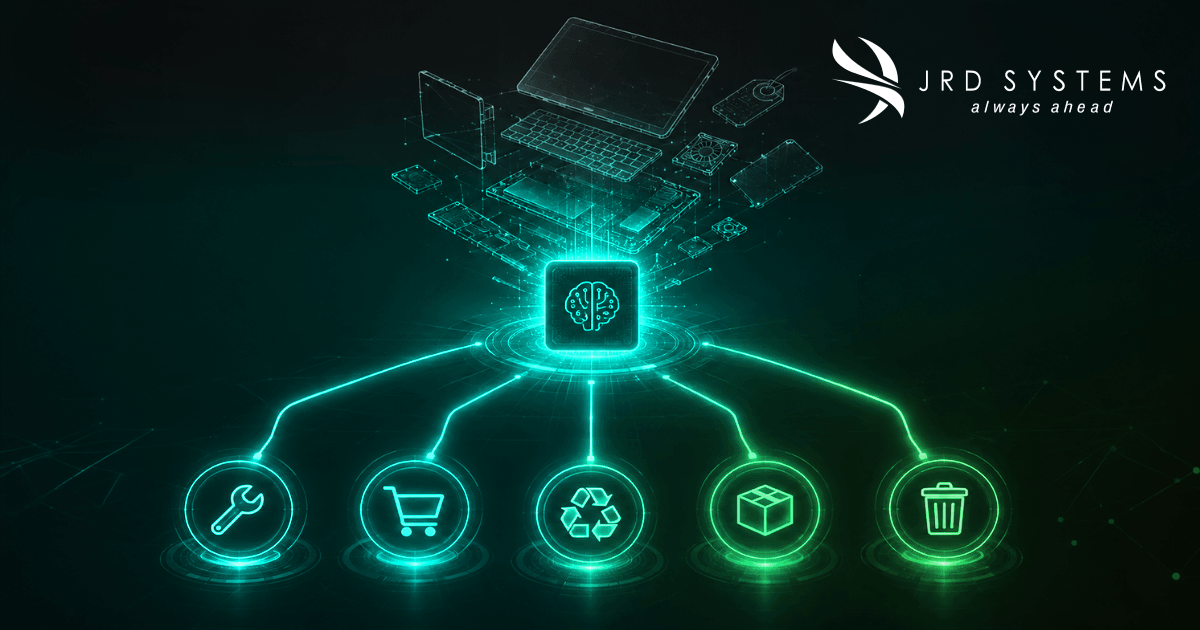
The Asset Nobody Owns
Every enterprise has an asset class it doesn’t manage.
It sits in a warehouse, depreciates by the day, and nobody on the executive team owns the decision about what to do with it. It isn’t real estate, aging equipment, or a legacy software license. It’s the inventory that customers send back.
Every other asset that behaves this way gets treated with discipline:
- Aging inventory gets a markdown calendar.
- Idle capital gets flagged by finance within a quarter.
- Underperforming equipment gets a depreciation schedule and a replacement decision.
- Returned goods get none of that. They arrive, they sit, and eventually someone makes a judgment call, with no clock running and no one tracking what the delay actually cost.
That gap has a name worth learning: decision latency. Not how fast an item physically moves through a warehouse, but the time between an item arriving and someone committing to what happens to it next. Two operations can process returns at the same physical speed and still have wildly different latency, because speed measures movement and latency measures indecision.
This distinction matters because value isn’t static. A returned phone, jacket, or appliance is worth less the longer it sits undecided. Every day of latency drains value from an asset already sitting in your building, already counted as inventory, already costing you space and capital. The better question isn’t how fast items move through the warehouse. It’s how long it takes anyone to actually decide what an item is worth and where it should go.
Why This Is Only Now Solvable
For years, this gap was tolerated because the variables behind a good disposition decision changed too quickly for a fixed rulebook to keep up:
A rule that made sense in January was often wrong by March. Manual judgment filled that gap, inconsistently, one item and one person at a time.
That has changed. AI models can now evaluate an item’s actual condition, weigh it against real-time market and depreciation data, and commit to a decision in the same moment the item is identified. The constraint was never a lack of ambition to fix this. It was a lack of a system fast and accurate enough to replace a human judgment call at the volume enterprises now operate at.
That system exists now, which is what makes decision latency a solvable problem for the first time, not just a known one.
The Asset Recovery Decision Framework
Each step depends on the one before it:
- Skip unified data, and AI evaluation is guessing with better math.
- Skip fast execution, and a good decision never reaches the floor in time to matter.
The framework only works end to end, which is exactly why point solutions, a grading tool here and a fraud filter there, rarely close the gap on their own.
What the Exposure Actually Looks Like
The scale here is not small.
Enterprises are on track to absorb close to $850 billion in returned merchandise value this year.
Online purchases come back at a materially higher rate than the rest of retail.
That’s the top-line number. The more precise cost sits inside categories where the math is already public:
- Electronics alone contain tens of billions of dollars in recoverable material value every year.
- The industry currently recovers only a fraction of it soundly. The rest is lost to decisions that came too late, were inconsistent, or were never made with the right information at all.
- Landfill still absorbs a striking share of what gets returned across developed economies, not because those items were worthless, but because nobody decided otherwise in time.
It's already visible in how the leading edge of the industry is closing the gap:
Verification technology that confirms a returned item's authenticity the moment it arrives, rather than after it ships back out, has moved a major apparel brand's return volume overwhelmingly toward in-person, instantly verified handling.
A manufacturer that once defaulted to discarding certain returned units outright replaced that default with a routing decision built on real resale and refurbishment economics and recovered well over a million dollars a year it had simply been writing off.
Same asset class, same underlying gap, two different points in the process. Both closed the same way: by shortening the distance between an item arriving and a confident, data-backed decision being made about it.
The Question Worth Asking
Do you know, right now, what your average time is between a return arriving and a final decision getting made? Not a guess. An actual number tracked the way you’d track days’ sales outstanding or inventory turns.
If the honest answer is no, that’s not really a failure on anyone’s part. It’s just the default state of an asset class that’s never been instrumented the way the rest of the balance sheet has.
Here’s a rough way to size it:
Decision Latency Cost ≈ Returned Merchandise Value × Daily Value Decay × Average Days to Disposition
Where:
- Returned Merchandise Value (RMV) is the total value of returned inventory sitting in your pipeline right now.
- Daily Value Decay is roughly how much value an item loses per day while it sits undecided. It varies by category, but it's rarely zero.
- Average Days to Disposition is your actual decision latency, and it's probably the one number in this equation you don't have yet.
Most finance and operations teams can already put a reasonable estimate on the first two. It’s that third one most organizations have simply never measured.
Put all three together and decision latency stops being an abstract operational problem. It becomes a financial metric you could put in front of a CFO, and it tends to be bigger than people expect, mostly because nobody’s ever been asked to actually calculate it.
How JRD Systems Would Close the Gap
JRD built its asset recovery approach around three coordinated capabilities, each one aimed at a specific point of latency in the framework above.
1. Unified data ingestion
As soon as the customer initiates their return, all sorts of information flow in from multiple sources:
- carrier tracking systems
- order management systems
- and inventory management systems at the warehouse
JRD utilizes AI-enabled ETL processes using Qlik Talend to gather, cleanse, and unify all this multi-channel data into an accurate item profile before the physical product even hits the loading dock. The clock really does start ticking before the item gets there.
2. AI-driven disposition intelligence
Once the item physically arrives, a disposition engine built on JRD's agentic AI architecture, the same modular, human-in-the-loop framework behind JRD AI Nexus, would evaluate it against real-time market demand and depreciation data and return a routing recommendation instantly:
- restock
- repair or
- liquidate
This is where latency actually gets engineered out. The call happens the moment the item is identified, not after it's already lost value sitting in a queue somewhere.
3. Mobile execution
None of that intelligence means much if it never reaches the person
holding the item.
JRD delivers the decision straight to dock workers through a rugged,
cloud-native mobile app built on AWS.
A worker scans the item, sees a clear instruction, and acts on it right
away. No spreadsheets. No waiting on a supervisor.
This is the architecture we believe closes the gap end to end, grounded in capabilities JRD has already put into production, applied to a problem we think deserves the same effort.
Conclusion
Reverse logistics has always been measured by how efficiently products move. That’s no longer the measure that actually decides who wins.
What decides it now is how quickly an organization can make good decisions about the products already sitting in its warehouses.
Enterprises that close decision latency won’t just process returns more efficiently. They’ll recover:
- more value from assets they already own,
- improve their sustainability position, and
- turn something that's quietly eroded margin for years into a function that's finally measured, managed, and accountable, the same way every other asset class already is.
With the continuing advancement of AI to revolutionize business processes within organizations, those who will consider the returned goods a managed asset class rather than just another process in their organization will be able to realize that value.
Want to know more about what is achievable? Find out how JRD Systems’ Agentic AI technology is helping enterprises make automated decisions and get results faster. Visit to our Agentic AI Solutions.
To stay updated on all things related to AI, business transformation, and intelligent automation at JRD Systems, follow us!