
Why 70% of Enterprise AI Projects Fail After Proof-of-Concept Stage

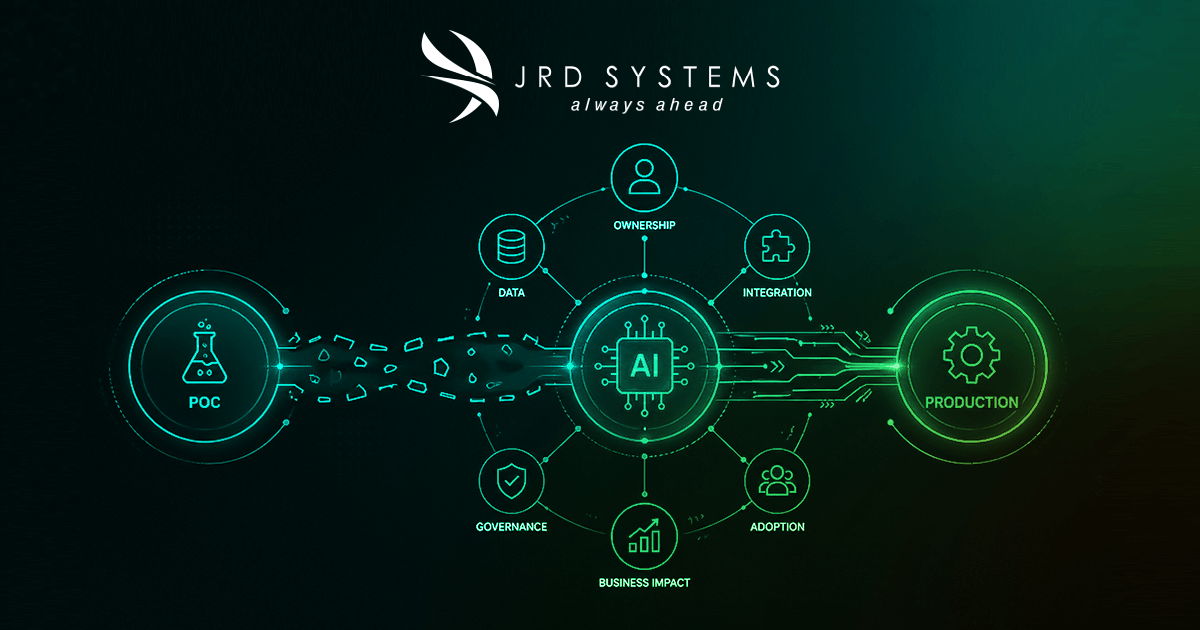
Across industries, most organizational projects do not underperform at the start. But they start failing after proving the work.
Teams are building proofs of concepts faster than ever, throughout organizations. Models provide strong accuracy, early results look like a good indicator, and leadership identifies momentum.
And then slowly progress slows down.
Budgets are questioned; ownership becomes unclear, and what looked like a working solution face challenge to survive in real operations.
This is when most AI initiatives come to a pause, not because the technology failed, but because the next stage of execution was not clearly planned.
At JRD Systems, we see leading enterprises redefining success from AI pilots to production as a critical shift in how AI delivers business value.
The Core Challenge
Across enterprises, the challenge does not start scaling. It begins earlier, at defining what success should look like beyond the proof of concept.
Industry research consistently indicates that while a majority of organizations invest in AI pilots, less than one-third successfully move them into production at scale with measurable business impact. The drop-off is not driven by model performance, but it is driven by the absence of a clear definition of how value transitions from experimentation to execution.
In many cases, teams are able to demonstrate that a model works. Accuracy is validated; outputs are consistent in a controlled environment, and early results appear promising.
But at this stage, a critical gap emerges.
It is not clear how the model will translate into business decisions, operational workflows, and sustained outcomes.
This is where momentum typically slows.
Proofs of concept operate in controlled environments: clean data, limited scope, and simplified dependencies. They are designed to answer a narrow question: Can this work?
Enterprise deployment needs a different question to be answered: How does this work inside the business, at scale, under real constraints?
The transition between these two questions is where most initiatives lose clarity.
As a result, organizations often proceed with a working model, but without clearly defining:
- where it fits within business operations
- who owns the outcome after deployment
- how success will be measured over time
- how the proof of concept aligns with defined return on investment
- whether the proof of concept integrates with existing processes or requires new operational workflows
The model performs in isolation.
The challenge is converting that performance into sustained business execution.
Where the Breakdown Typically Happens
1. AI Starts as Innovation but Needs to Operate as a Business Capability
Most AI initiatives start within innovation programs. The initial focus is on exploring use cases, validating ideas, and demonstrating value quickly.
As the PoC shows results, expectations naturally shifts. The same initiative is now expected to support ongoing business results.
At this stage, the shift from experimentation to execution is not always clearly defined. Ownership, operating models, and funding structures often remain aligned to the initial phase.
This creates a gap between what has been proven and what is required to sustain it in real operations.
2. Early Use Cases Prioritize Feasibility Over Impact
In the early stages, use cases are often selected based on how quickly they can be demonstrated. Clean data, well-defined patterns, and limited dependencies make it easier to show results.
While this accelerates validation, these use cases do not always translate into meaningful business results.
As organizations move toward growing, the effort required to integrate, maintain, and operationalize these solutions becomes clearer. In some cases, the complexity outweighs the value they were designed to deliver.
3. Data Readiness Evolves from Preparation to Ongoing Capability
During PoCs, data is typically prepared specifically for the model. It is structured, cleaned, and optimized for performance.
At scale, data behaves differently.
Organizational data is distributed, continuously changing, and managed throughout multiple systems and teams. Making it usable becomes an ongoing responsibility.
This shift from preparation to continuous data management is often more extensive than initially expected, affecting consistency and reliability in production environments.
4. Integration Extends Beyond Systems into Decision-Making
Integrating AI into the business involves more than connecting it to existing systems. It needs clarity on how decisions are made and acted upon.
Questions such as who uses the output, how it fits into workflows, and how exceptions are handled become central.
When these aspects are addressed later in the process, integration can take longer than anticipated, with dependencies throughout operations, IT, and governance functions.
The model functions as intended but embedding it into day-to-day operations needs broader alignment.
5. Adoption Develops Through Structure
The value of AI is realized only when it is consistently used in decision-making.
In practice, adoption takes time. Teams require clarity on when to rely on AI, how to interpret outputs, and how it fits into existing processes.
Without defined ownership, communication, and enablement, usage can remain limited, even when the underlying solution is sound.
Adoption, therefore, becomes an active part of the implementation and not a natural outcome.
What Needs to Change
Organizations that move beyond the PoC stage approach AI differently. They do not consider it as an experiment that requires scaled. But they treat it as a business capability which requires it to be built.
This needs a shift in how decisions are made:
- Ownership is defined before scaling begins
- Every initiative has a business leader responsible for outcomes
- Problems are selected based on impact and not convenience
The focus is on areas where improvement changes business performance, even if complexity is higher.
- Data is treated as an ongoing investment and not as a one-time preparation step.
- Integration is planned early; AI is designed to fit into workflows from the beginning, not added later.
- Adoption is actively managed.
- Success is measured by usage and decisions influenced and not just model performance.
Closing the Gap Between AI and Business Execution
At JRD Systems, we work with organizations at different stages of their AI journey, from defining where to start, to ensuring solutions deliver measurable business outcomes at scale.
For organizations starting from scratch, the focus is on selecting the right problems, areas where AI can create meaningful business impact and not just demonstrate technical feasibility. This includes aligning stakeholders early, establishing ownership, and building data and system foundations that support long-term use.
For organizations that have already validated AI through proofs of concept, the focus shifts to execution. This involves integrating solutions into real workflows, addressing data complexity, and ensuring that outcomes are consistent in production environments.
Across both scenarios, the approach remains consistent.
AI is not treated as a standalone initiative. It is built as part of how the business operates, aligning to decision-making, supported by reliable data, and designed for adoption from the beginning.
With experience across data engineering, cloud platforms, and enterprise systems, we focus on the areas that determine whether AI delivers value over time, problem selection, data readiness, integration, and adoption.
Because the real measure of AI is not whether it works once.
It is whether it continues to deliver as the business evolves.
Conclusion
The high failure rate of organizational AI projects is not caused by limitations in technology. It is driven by how organizations approach scaling.
Proofs of concepts are controlled and isolated. Businesses are not.
The transition from one to the other needs alignment across ownership, data, systems, and people. Without that alignment, even the best models remain unused.
The question is not whether AI works. It is whether the organization is structured to use it.
Discover how to operationalize AI beyond proof of concept and drive measurable outcomes: https://jrdsi.com/agentic-ai-solutions/