
Using AI to Upgrade Legacy Systems:
Why the 20% Rule Defines a Smarter Modernization Path
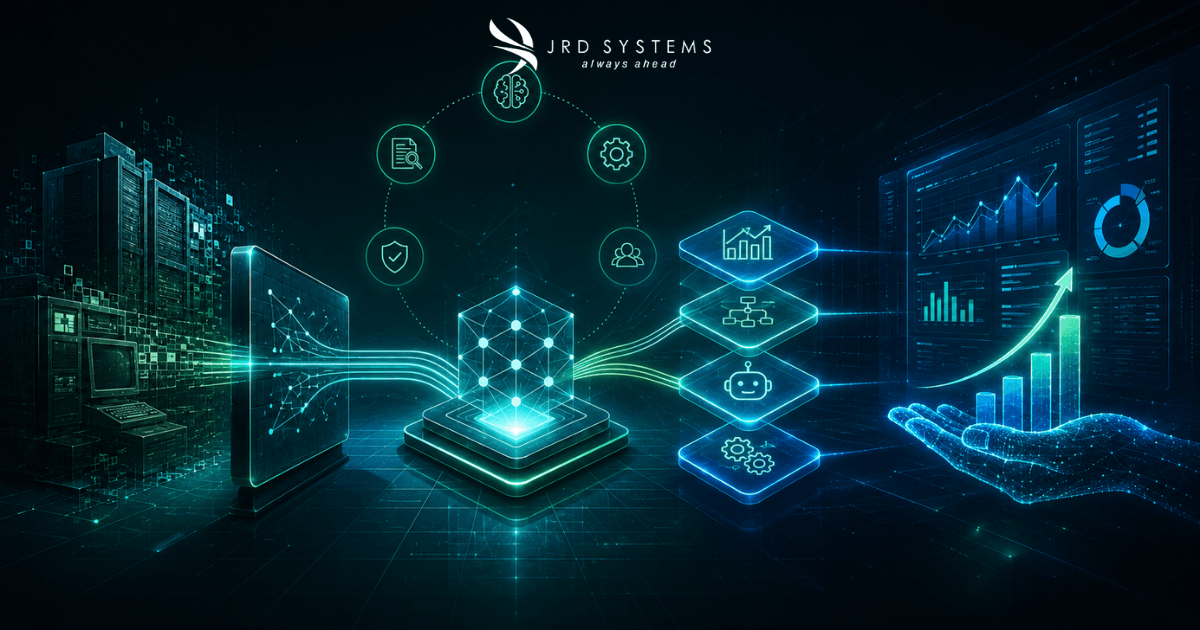
The Setup Most Enterprises Are Living In
A few months ago, one of our clients in the automotive distribution space pulled us into a call. They had a billing engine running on a system the original vendor no longer supported. The team that built it had retired. Every new compliance change cost them weeks. Every new analytics request bounced off the same wall: “the legacy core can’t expose that data.”
They were not alone.
Across the logistics, banking, healthcare, automotive, and distribution industries we serve at JRD Systems, the same picture repeats. There is a backbone that works. There is 20% of the operation that is bleeding. And there is an internal debate about whether to rebuild from scratch or freeze everything for eighteen months.
This blog is for the people stuck in that debate.
It is also the reason we build the way we build: gradual transformation, structured integration layers, and an AI layer that meets the legacy where it stands, instead of one that demands it to move or radically change.
Why the Big-Bang Upgrades Still Fails in 2026
“The architecture that once worked… now holds you back.”
That line from our earlier work on monolithic systems still applies here. Every modern AI-led mainframe exit attempt faces the same statistical reality today:
- Gartner's most recent estimate warns that more than 70% of AI-assisted legacy exit projects will fail through 2026, and that roughly 75% of vendors in this space will pivot or fold by 2030.
- More than 50% of GenAI projects are abandoned after proof of concept, according to Gartner's own research.
- Nearly 40% of companies measuring AI cost savings land below 10%, despite targeting 11% to 20% returns - yet 90% are still increasing their budgets as per Bain & Company, 2026.
- Only 30% of organizations in a recent HBR Analytic Services survey reported that AI is materially impacting new revenue streams.
That last data point matters the most. AI budgets are not a problem. AI placement is.
Organizations are putting AI where the architecture is least ready for it. They are replacing instead of integrating. They are treating the legacy core as an obstacle instead of a foundation.
This is exactly the moment where frameworks from JRD Systems were built to help.
What We Actually See Across Our Engagements
| Pattern in the Legacy Estate | What it Tells Us |
| A transaction engine that nobody touches, but everyone depends on | The backbone is sound, do not replace it |
| Approval workflows handled by email + spreadsheets | This is the 20% where AI creates immediate value |
| Compliance reporting that pulls from six different screens manually | A read-only AI agent can own this in days |
| Customer service reps rekeying data between two systems | An orchestration layer between them is the right fix |
| Analytics teams blocked by the inability to query the core | AI-enabling the data path, not the core, is the answer |
The 80/20 Reframe, In Our Language
We do not start a legacy AI engagement with a rewrite. We start with one sentence:
“Find the workflow where every team is losing hours, the core is untouched, and the surrounding data is reachable.”
That sentence defines the 20%.
From there, we apply a model that is consistent across our AI-enablement work:
-
Layer 1: Read & Observe:
AI agents connect to the legacy system the same way an authorized human user does. They read screens, parse screens, monitor transactions, and surface anomalies. Nothing in the core changes. -
Layer 2: Act & Orchestrate:
AI agents execute bounded actions inside defined policy. They pull data into downstream systems. They trigger events. They never bypass the legacy's own rules. -
Layer 3: Decide & Recommend:
For higher-value workflows, AI generates recommendations that a human signs off on. This is the most common layer in banking and healthcare work, where audit trails are non-negotiable. -
Layer 4: Replace & Retire (only when nothing depends):
A legacy module is retired only when Layers 1 to 3 have absorbed its load, and the dependent workflows are running through AI-native paths instead.
This is not a generic maturity model. This is the working pattern we use when an automotive distributor, a bank, or a healthcare network asks, “where do we start?”
Where This Connects to Our Existing AI Stack
The reason this approach is repeatable for us is that it is not a new initiative at JRD Systems. It is the way our existing platforms were designed.
Agentic AI Solutions are the operational layer. They run bounded actions, observe legacy systems, and act within defined policies. This is Layer 1 and Layer 2 above, productized.
JRD AI Nexus is the integration and orchestration backbone. It is what connects the legacy core to modern data, analytics, and AI services without rewriting either side.
AI-Enabled ETL is how we move data out of the legacy estate into real-time analytics layers without waiting on a multi-year data migration. It is what powers the analytics visibility for clients who cannot yet touch the core.
LevelUp Genie is the AI layer we use for guided end-user experiences — particularly useful when a customer-facing team’s workflow still depends on a legacy screen they would otherwise be retrained on.
Together, this is how AI-Enabled ETL, Agentic AI Solutions, and JRD AI Nexus solve the 20% problem in legacy estates — without disturbing the 80% that is working.
Some Of The Real Challenges We Run Into (And How We Solve Them)
This is not a marketing pitch. The work is not always clean. Here is what we actually see:
Challenge 1: The legacy has no published API
What we see:
Older enterprise systems expose only screen-based or batch-file interfaces. There is no clean REST endpoint to read from.
How JRD approaches it:
Our agent layer reads the system the way a human would, by interacting with its UI or parsing its output files. AI has matured to a point where screen-aware automation, guided by business rules, is reliable enough for non-critical observability and reporting. We never let that pattern touch a regulated transaction.
Challenge 2: Compliance requires an audit trail
What we see:
Especially in banking and healthcare, every AI action must be traceable and explainable to satisfy strict regulations, pass audits, and prove accountability.
How JRD approaches it:
Every agent is wrapped in policy controls. Every action is logged at the orchestration layer (typically JRD AI Nexus), so the audit story is identical to what an in-house team would build. This is also why our Data Analytics & AI Insights team works alongside the Agentic AI team on every engagement. Governance cannot be an afterthought when AI is touching a regulated core.
Challenge 3: The integration surface keeps shifting
What we see:
The legacy estate is rarely one system. It is typically a web of CRM, ERP, billing, and reporting tools stitched together over a decade.
How JRD approaches it:
This is where our Cloud Solutions & Infrastructure and Low-Code/No-Code work meets our AI layer. The legacy does not get a full data migration. Instead, an orchestration layer (often powered by Qlik Talend integrations for our data-centric clients) creates the read-and-write paths that AI agents use. The composition matters more than the rewrites.
Challenge 4: The team running the legacy is shrinking
What we see:
The institutional knowledge of how a 15-year-old system actually behaves is concentrated in three or four people, all close to retirement.
How JRD approaches it:
AI agents absorb the repeatable parts of that knowledge. They document the system, surface exceptions, and recommend actions in the language the legacy expects. The remaining human experts shift to policy and exception handling, where their experience is most valuable.
Challenge 5: Everyone is piloting AI, but no one is integrating it
What we see:
A client has six AI pilots running. None of them talk to each other. None of them have an owner. This is the HBR data point above showing up in real life.
How JRD approaches it:
We bring Structured Integration Layers and a connected governance model, not a new tool. The goal is for AI agents, AI-enabled ETL jobs, and analytics pipelines to share identity, policy, and observability. This is the integrated approach we have been writing about across our recent AI governance work.
Challenge 1: The legacy has no published API
What we see:
Older enterprise systems expose only screen-based or batch-file interfaces. There is no clean REST endpoint to read from.
How JRD approaches it:
Our agent layer reads the system the way a human would, by interacting with its UI or parsing its output files. AI has matured to a point where screen-aware automation, guided by business rules, is reliable enough for non-critical observability and reporting. We never let that pattern touch a regulated transaction.
Challenge 2: Compliance requires an audit trail
What we see:
Especially in banking and healthcare, every AI action must be traceable and explainable to satisfy strict regulations, pass audits, and prove accountability.
How JRD approaches it:
Every agent is wrapped in policy controls. Every action is logged at the orchestration layer (typically JRD AI Nexus), so the audit story is identical to what an in-house team would build. This is also why our Data Analytics & AI Insights team works alongside the Agentic AI team on every engagement. Governance cannot be an afterthought when AI is touching a regulated core.
Challenge 3: The integration surface keeps shifting
What we see:
The legacy estate is rarely one system. It is typically a web of CRM, ERP, billing, and reporting tools stitched together over a decade.
How JRD approaches it:
This is where our Cloud Solutions & Infrastructure and Low-Code/No-Code work meets our AI layer. The legacy does not get a full data migration. Instead, an orchestration layer (often powered by Qlik Talend integrations for our data-centric clients) creates the read-and-write paths that AI agents use. The composition matters more than the rewrites.
Challenge 4: The team running the legacy is shrinking
What we see:
The institutional knowledge of how a 15-year-old system actually behaves is concentrated in three or four people, all close to retirement.
How JRD approaches it:
AI agents absorb the repeatable parts of that knowledge. They document the system, surface exceptions, and recommend actions in the language the legacy expects. The remaining human experts shift to policy and exception handling, where their experience is most valuable.
Challenge 5: Everyone is piloting AI, but no one is integrating it
What we see:
A client has six AI pilots running. None of them talk to each other. None of them have an owner. This is the HBR data point above showing up in real life.
How JRD approaches it:
We bring Structured Integration Layers and a connected governance model, not a new tool. The goal is for AI agents, AI-enabled ETL jobs, and analytics pipelines to share identity, policy, and observability. This is the integrated approach we have been writing about across our recent AI governance work.
What The Staged Rollout Actually Looks Like
When a client engages us on a legacy AI modernization, the rollout we run is a six-stage sequence. It looks like this in practice:
Stage 1
Discovery: We map the legacy estate. We identify the top 10 workflows by hours-lost-per-week. We rank them by data accessibility and reversibility. This becomes the 20% list.
Stage 2
Single Workflow Pilot: We pick one workflow, typically something compliance-adjacent or analytics-adjacent, where success is measurable, but blast radius is small. We ship a working Agentic AI layer against it.
Stage 3
Measure & Prove: Time-on-task reduction. Error rate. Audit completeness. Throughput. We share results with the client's stakeholders before discussing what comes next.
Stage 4
Expand the Layer: Once one workflow is running cleanly through JRD AI Nexus, we extend it to the next 2–3 workflows. We use the same integration pattern. We do not redesign per workflow.
Stage 5
Connect Analytics: With legacy data now flowing through AI-Enabled ETL in near-real time, we expose that data to the Data Analytics & AI Insights layers. This is where the business finally gets the visibility they were told the legacy could not give.
Stage 6
Retire Only What Is Ready: A legacy module is retired once AI has absorbed its real-world load for a sustained period. This is not a target date. It is an outcome.
This is gradual transformation in the truest sense of the phrase. The customer experience modernizes first. The legacy backbone stays until it is genuinely redundant.
What Success Looks Like: From Our Actual Engagements
Across industries, we see similar outcomes when this sequence runs cleanly:
- 30 days: One workflow automated, audit-ready, and integrated into existing reporting. A measurable first number to share with leadership.
- 90 days: Three to five workflows live. The first round of legacy-read access costs zero engineering time.
- 180 days: Legacy core is isolated from backend processing. The user experience is fully AI-mediated, but no legacy data is exposed that wasn't already exposed.
- 365 days: A system that feels modern because to every customer and employee, it is while the underlying estate is exactly where it was, doing exactly what it always did, just no longer the bottleneck.
For industries with heavy compliance exposure like banking and healthcare, we typically run this two-speed: customer-facing modernization moves fast, but each regulated workflow is gated by additional observability before AI is allowed to act on it.
For industries with high operational complexity like logistics and distribution, the first workflows we typically automate are exception handling and reporting, where the legacy is read-only anyway.
Why This Is a JRD Approach
We could have built a generic modernization practice that leads with a flagship framework. There is a market for that. We chose not to.
What we built instead is a set of platforms – Agentic AI Solutions, JRD AI Nexus, AI-Enabled ETL, LevelUp Genie – which are designed to coexist with legacy estates rather than replace them. The 80/20 approach to AI modernization is not something we sell separately. It is how our entire service portfolio is shaped, from Cloud Solutions to Data Analytics & AI Insights to QA Automation.
The reason we can show outcomes fast is that our layer, our orchestration, and our analytics already speak to each other. The reason we can retire legacy modules safely is that we never ask the legacy to do something it was not designed to do.
That is the difference between a modernization strategy that holds, and a modernization strategy that turns into a parallel IT estate.
If you are a CIO, a head of enterprise architecture, or a transformation lead in one of the industries we serve, the next conversation is probably this:
“Do we go big-bang, or do we wait, or do we try the 80/20 path?”
Three things to take into that room:
- The 80% is probably fine. The Gartner-cited failure data is not because modernization is hard. It is because modernization replaces too much. The core is rarely the problem. The connections around it are.
- AI belongs at the orchestration layer, not in the core. JRD AI Nexus and the Agentic AI layer are designed exactly for this. They read, observe, and act on the edges. They do not require the core to change.
- The 20% can show value fast. A single bounded workflow, with measurable hours-saved and audit-ready output, is enough to fund the next three. You do not need an 18-month business case.
That is the practical playbook. It is also the way we work.
Legacy modernization is not a refresh project. It is a structured integration problem with an AI layer on top.
At JRD Systems, we believe the answer is not to rebuild every system that still works. It is to wrap the systems that work, expose the data they hold, give the workflows around them an AI-driven interface, and retire legacy modules only when they have become genuinely unnecessary.
If your enterprise is stuck in that AI debate, the next step is usually a discovery with our team.
Talk to us at contact@jrdsi.com or (586) 416 1500. We will walk through the legacy estate, identify the 20% that is ready for AI today, and show what a structured rollout looks like in your specific stack.