
Why Integration Is the Core Strategy: From Monoliths to Composable Systems
The Architecture That Once Worked… Now Holds You Back
At a point of time building everything into one system made perfect sense, but Monoliths gave teams the control, predictability and a single place for managing everything.
But today, businesses don’t move in a straight line anymore. New tools are added continuously. Customer expectations shift quickly than release cycles. And what once felt balanced now feels restrictive.
Research on software architecture evolution indicates that as systems grow, monoliths start to slow down innovation, because they weren’t designed for constant change.
Breaking the System Didn’t Solve the Problem: It Shifted It
Moving to microservices was planned to fix everything. Smaller services, independent deployments, faster releases, and this sounded like an answer.
And it was in multiple ways. But something else unfolded quietly in the background.
As systems became more dispersed, the real challenge was not building services, but it was connecting them. Studies highlight that communication, coordination, and data consistency have rapidly become the hardest problems to solve.
So, the question changed from “How do we break systems apart?” To “How do we make everything work together?”
Composable Systems: Building for Change
This is where composable thinking steps in… not as a trend, but as a response to complexity.
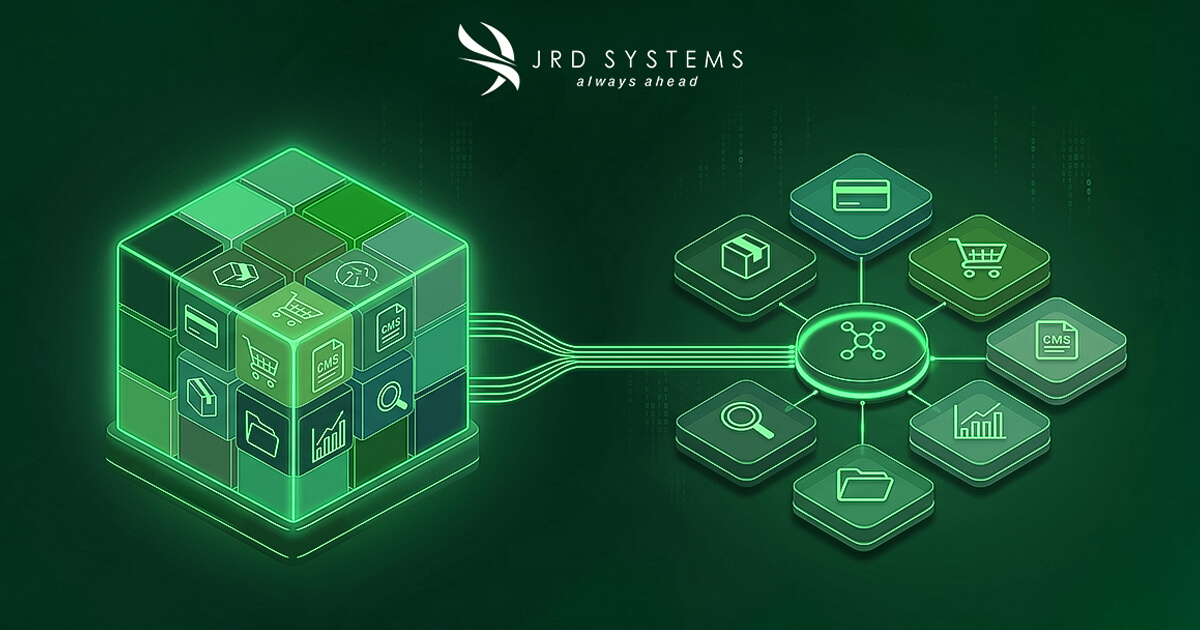
Composable systems are about designing systems which can continuously evolve. Capabilities are treated as building blocks which can be assembled, reassembled, and extended without affecting the whole.
This approach lets organizations adapt faster while minimizing long-term system rigidity.
The real shift here is subtle but powerful. Systems are designed to be continuously assembled.
The Hidden Core: Integration Is No Longer a Layer
As systems become composable, integration stops being just a technical layer. It becomes the basis that everything depends on.
Without strong integration, composable systems rapidly turn into disconnected pieces. Data starts living in silos again. Processes lose continuity. And the promised flexibility turns into operational friction.
This is why integration is not an afterthought. It is the strategy that determines whether composability actually works.
Why Integration Becomes the Core Strategy
At organizational level, systems don’t fail because individual components don’t work, but they fail as these components don’t work together.
Research shows that the challenge is not within the service, but it’s between – data synchronization, service coordination, failure handling, and visibility.
As the architecture becomes more segmented, the number of interactions grows exponentially. Each new service, platform, or application can add more dependencies, more data flows, and more points of downtime.
This is why integration shifts from being a technical concern to a strategic one.
It defines:
- How quickly systems can adapt
- How reliably data moves across the organization
- How seamlessly business processes function end-to-end
In this composable architecture, integration is what retains the system together. Without this, modularity creates disconnection instead of flexibility.
Cloud and Low-code/no-code Changed Ownership
Cloud platforms made it easier to scale and distribute systems, but they also introduced a wider ecosystem of services that need to work together.
At the same time, Low-code/no-code platforms changed who builds applications. Business teams are now part of the development process, creating solutions closer to the problem.
This combination is powerful, but it also increases complexity. More applications are being built, more tools are being adopted, and more connections are required.
Without a clear integration approach, this speed can lead to division instead of progress.
The Real Challenge Today: Orchestration
Modern organizations are managing cloud platforms, legacy systems, SaaS applications, and Low-code/no-code solutions: all at once.
Each of these systems works well individually, but challenge lies in making them function as one cohesive ecosystem.
This is where orchestration becomes crucial. It’s not just about connecting to APIs. It’s ensuring that data flows consistently, processes remain aligned, and decisions are based on a unified view.
Organizations that solve this move with clarity.
What Strong Integration Actually Looks Like
Integration is not about adding more connectors or APIs, it needs a well-defined approach on how systems communicate, share data, and progress together.
Key principles on which organization with composable systems focus on:
-
Integration as a Design Principle
Systems are built on clear contracts, standardized interfaces, and reusable integration patterns from the start. -
API-First and Event-Driven Thinking
Systems communicate through well-defined APIs and events, instead of strong coupled connections, letting flexibility without breaking any dependencies. -
Centralized Visibility with Decentralized Execution
Teams are built independently, but data flows and system interactions remain visible and governed. -
Data Consistency as a Priority
Integration ensures that data is not just connected, but aligned, reducing disruption over the platforms. -
Orchestration Over Point-to-Point Connections
Instead of managing hundreds of direct integrations, orchestration layers coordinate workflows across systems, ensuring continuity.
This is when integration becomes more than connectivity. It becomes a structure that lets systems scale without losing coherence.
Where JRD Systems Fits into This Shift
At this stage, transformation is not about introducing new systems but it’s about making everything work together with clarity and control.
At JRD Systems, our focus is on enabling integration as a basis, not an afterthought.
Instead of pushing for large-scale replacements, the approach centers on gradual transformation, where legacy systems, cloud platforms, and modern applications are connected through structured integration layers.
By combining cloud capabilities with platforms like Qlik and Appian, we help organizations:
- Establish consistent data flow across systems
- Build reusable integration frameworks
- Support LCNC environments without losing governance
- Maintain visibility across distributed architectures
The goal is not just to modernize systems, but to ensure they remain connected, adaptable, and aligned over time.
The move from monoliths to composable systems is often described as an architectural evolution. But in reality, it’s a shift in how organizations think about technology.
It’s about building a system which can be adapted and integrated which can hold everything together.
Because ultimately, the strength of a system can be defined by how well it connects with everything around it.